
The Dynamic Atlas of Riverine Ecosystems and Infrastructure (DARE) Project seeks to understand, at a global scale, how rivers and their ecosystems have responded to past human actions.
DARE Research Questions:
- How have operational decisions shaped the management of hydraulic infrastructure over the past decades, and what impact have they had on river discharge and ecosystems?
- What is the uncertainty associated with reconstructed historical records, and how does it affect our confidence in global assessments of river change?
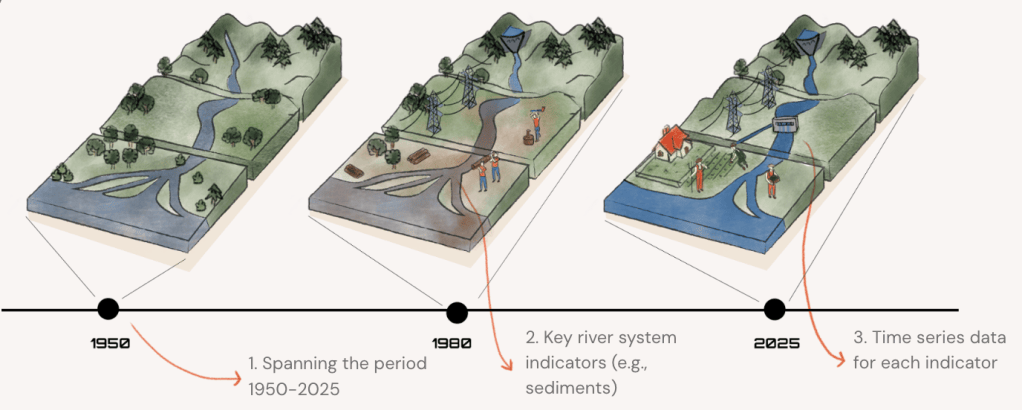
DARE is a five-dimensional dataset. It combines:
- Three spatial dimensions
- One temporal dimension (1950–2025)
- One uncertainty dimension (confidence bounds around key variables)
By capturing where, when, and what changes have occurred in rivers, DARE will establish a foundation for assessing the role of human interventions in shaping rivers.
The atlas will also identify who the key actors are in driving these transformations and quantify their ecological consequences.
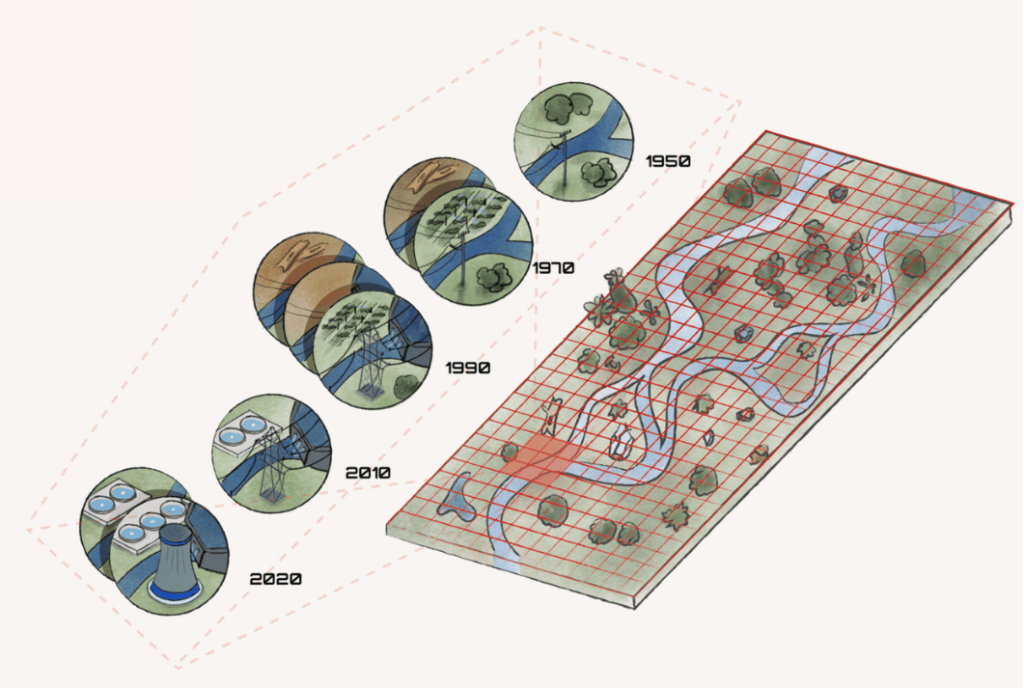
By systematically capturing where, when, and what changes have occurred in river discharge and HI operations, DARE will establish a foundation for assessing the role of human interventions in shaping rivers. The atlas will also identify who the key actors are in driving these transformations and quantify their ecological consequences.
Finally, by uncovering how different human actions contributed to observed changes, it will offer critical insights into river ecosystem responses to socio-environmental pressures. Conceptually, DARE is a five-dimensional dataset: it combines three spatial dimensions with one historical temporal dimension (1950–2025) and one uncertainty dimension, representing confidence bounds around key variables and capturing the range of plausible past conditions across hundreds of scenarios.
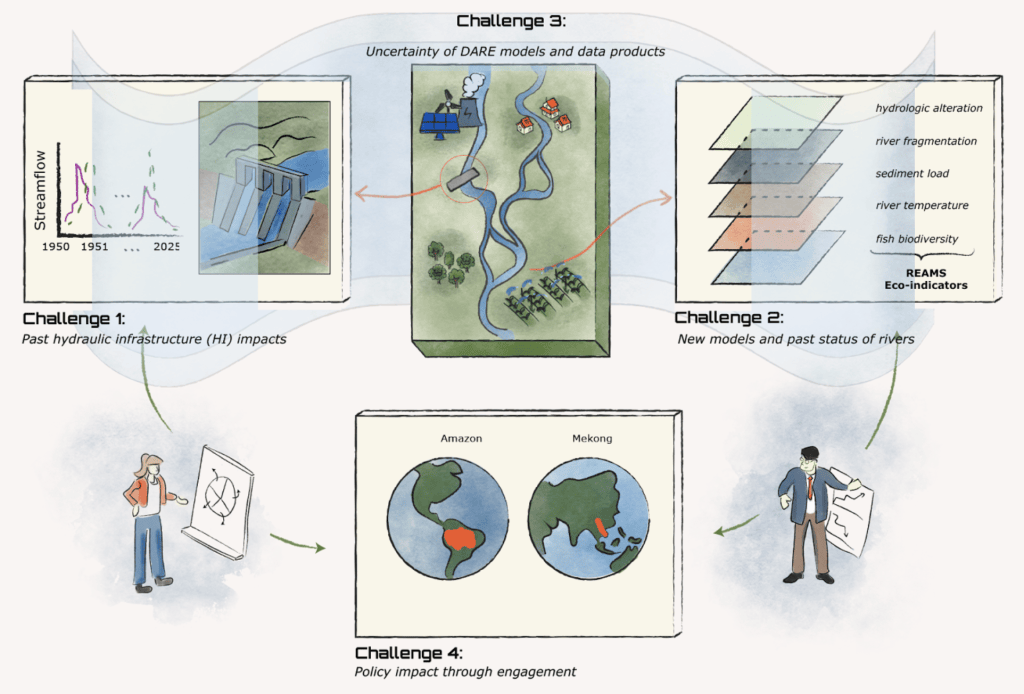
The research is structured into three grand challenges that will produce different components of DARE (C1-C2) and characterize their uncertainty (C3). The fourth challenge (C4) will validate DARE and explore its policy impact. While our approach is global, we also focus on two sentinel sites (Amazon and Greater Mekong) for data and model validation, as well as policy development.
DARE is a unique project in its scope, and temporal scale. The DARE team will work in collaboration with the other VIEW projects to advance our understanding of global freshwater availability and its evolution in order to manage water effectively and equitably today and in the future. Learn more about the other VIEW portfolio projects here.
Learn more about DARE’s Scientific Challenges:
Challenge 1: Historical Impacts
Discovering past hydraulic infrastructure management and its impact on river discharge. Learn more ->
Challenge 2: Riverine Ecosystem Indicators
Linking hydraulic infrastructure management and alterations, to the status of riverine ecosystems. Learn more ->
Challenge 3: Exploring uncertainty
Uncertainty characterization of DARE models and data products. Learn more ->
Challenge 4: Policy Impacts
Policy impacts through stakeholder engagement. Learn more ->
 DARE Project