
Joudat Bint Khalil
DARE Research Associate, University of Maryland
“My academic and research experiences have shaped my expertise in the water–energy–food nexus and my interest in exploring integrated solutions to complex sustainability challenges that account for multi-sector dynamics.”
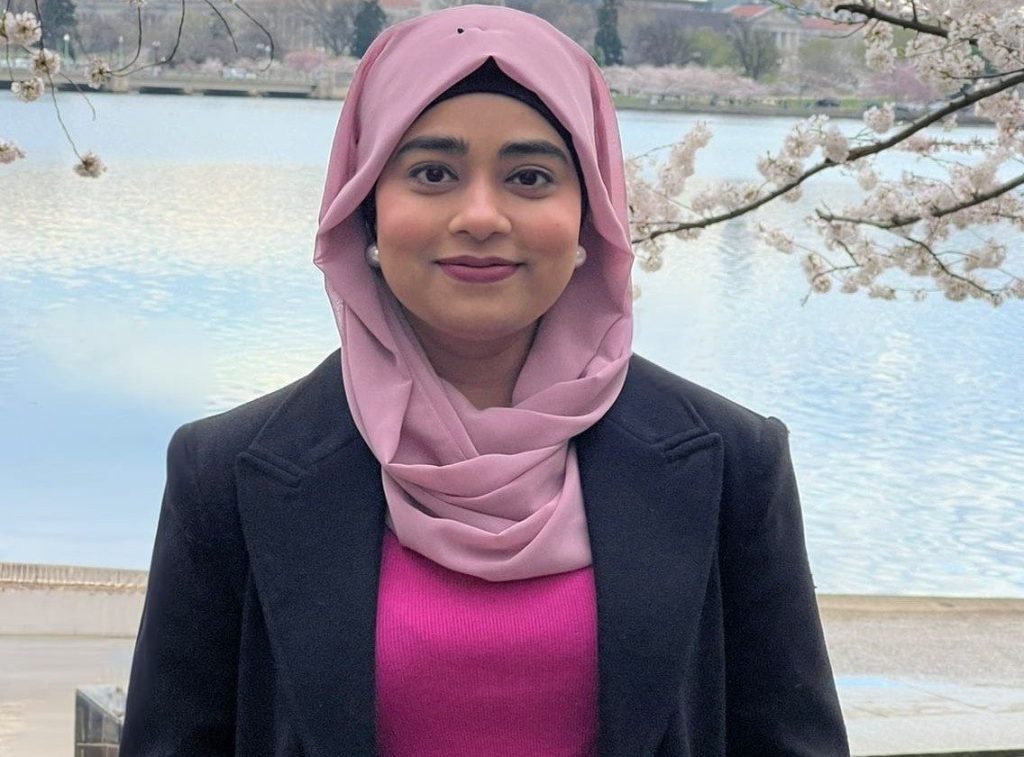
Joudat holds a master’s degree in electrical engineering from Lahore University of Management Sciences, Pakistan with specialization in systems and control. Prior to joining DARE, she worked at the Earth System Science Interdisciplinary Center (ESSIC), housed within the University of Maryland. She worked on an NSF project led by Dr. Thomas Wild on nexus exploration of opportunities in the South American sub region. During her time at ESSIC, she developed a coupled GCAM–GridPath framework to design decarbonization scenarios and assess the impacts of climate targets on power system operations, as well as studied the effects of riverine biodiversity conservation criteria on hydropower expansion in the sub region.
Currently, she works with the Center for Global Sustainability as a Faculty Assistant, where she helps lead the development of thermoelectric water withdrawal dataset as part of DARE Challenge 1. Her work involves collecting and wrangling large datasets, developing consistent plant-level information globally, and preparing these data for use in power-system modeling. Part of her work also involves identifying the cooling technologies and water sources used by individual thermoelectric power plants. Since this information is not consistently available globally and is often limited to only a few countries, she finds building a comprehensive dataset both challenging and interesting. She is also supporting the setup of a global power-system planning model, that will help in estimating the thermoelectric water diversions.
In parallel, she is a contributor to the development of GridPath for the ASEAN Power Grid. This work focuses on identifying potential investments and operational strategies for regional grid infrastructure under different energy and economic pathways, while examining how greater coordination and electricity trade across ASEAN countries could support the midcentury transition toward net-zero emissions.
When asked what she finds exciting about DARE, Joudat said:
“I am especially excited to reconstruct historical thermopower portfolios. Most of my modeling experience so far has focused on forward-looking scenarios and future projections, so I find the opportunity to work retrospectively particularly interesting. Reconstructing how power systems evolved in the past offers a different perspective and can help us better understand the factors that shaped today’s energy systems. While my work focuses specifically on the thermoelectric sector, I find it fascinating to see how this piece fits together with other processes and human influences across the water cycle to build a more comprehensive picture of how river systems have changed.”
 DARE Project
Leave a comment